 Facts checked Nov 18, 2026
CISA calls Java4Shell (CVE-2026-114938) critical, and finder Calif says it got remote code execution before login in six common Java products. Three conditions must hold, so most fleets can shrink tonight's list.
The flaw is a memory-corruption bug in the Base64 decoder of the x86-64 HotSpot JVM, CISA says. Calif says the optimized routine mishandles end padding and writes past the output buffer into neighboring heap memory. OpenJDK and Oracle released fixes on Nov. 17, 2026.
Is a system exposed?
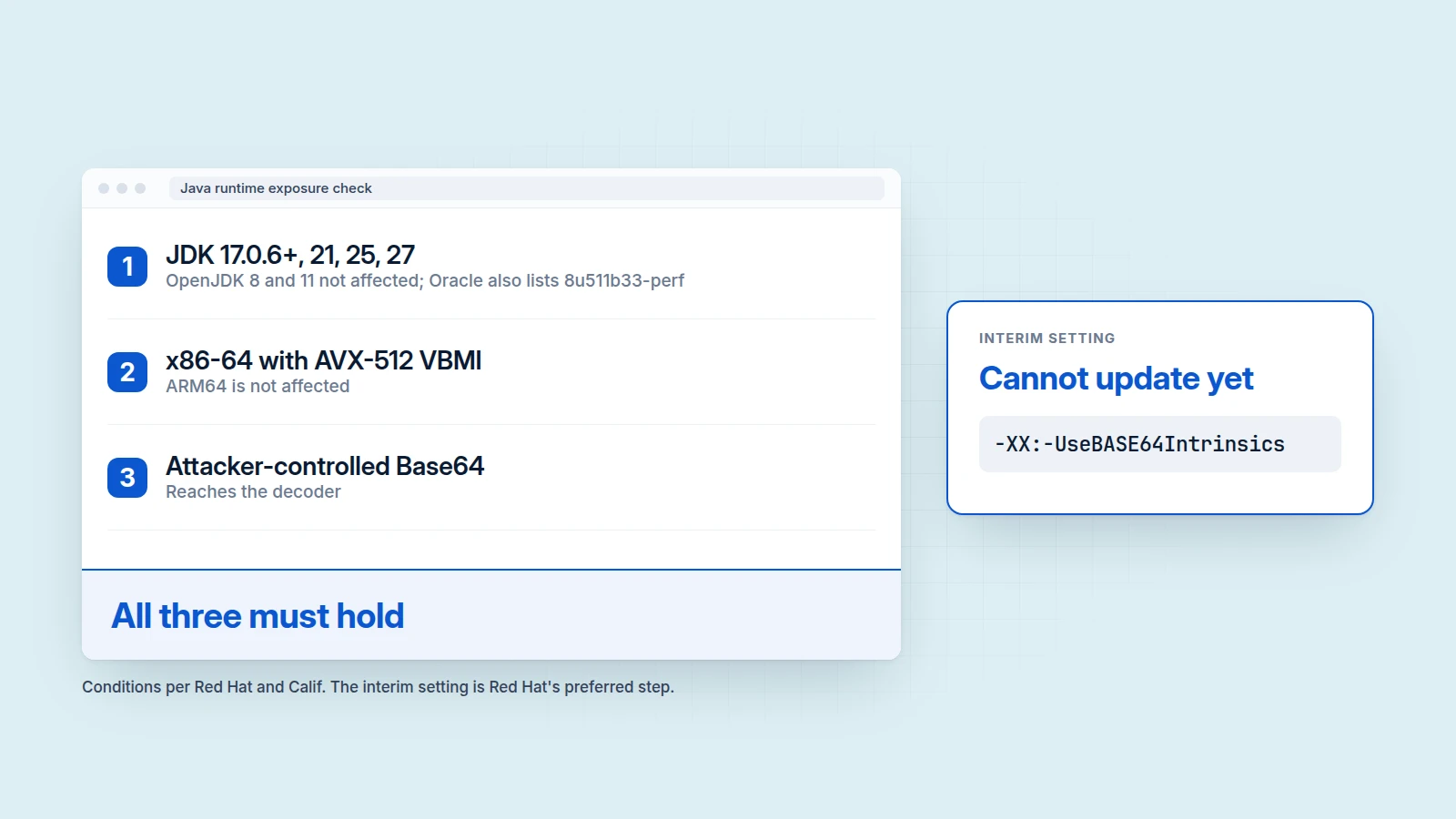
All three must hold, per Red Hat's bulletin and Calif:
- JDK train. OpenJDK 17 (17.0.6 and later), 21, 25 and 27. OpenJDK and Red Hat say 8 and 11 are not affected; Oracle separately lists its own 8u511b33-perf build, GraalVM for JDK 17.0.21.0.3 and 21.0.13.0.3, and GraalVM Enterprise Edition 21.3.20.0.3.
- CPU. An x86-64 chip with AVX-512 VBMI: Intel Ice Lake, Sapphire Rapids, Emerald Rapids, Granite Rapids, or AMD Zen 4 and newer. ARM64 is not affected, nor is a JVM started with
-XX:UseAVX=2or lower. - Input. Attacker-controlled Base64 must reach
java.util.Base64.Decoder. Red Hat says HTTP Basic credentials, SAML artifacts, CSRF tokens and MIME encoded words are routinely decoded before login completes.
Calif also says a Java client that opens a TLS connection to a malicious server can be compromised, an exploit samczsun shared with it. Outbound clients count too.
Severity differs by source: Oracle scores it 8.1 High (AC:H), Red Hat 9.8 (preliminary), Calif 9.2 under CVSS 4.0.
Is anyone exploiting it?
As of 11:55 UTC on Nov. 18, the flaw is not in CISA's KEV catalog, and CISA's entry in the CVE record, dated Nov. 17, says exploitation "none" and automatable "no". Calif has published a trigger reproducer, withholds product exploit chains, and says there is "no universal exploit". We expect the first real attacks to target the six products it names.
Who found it, and how?
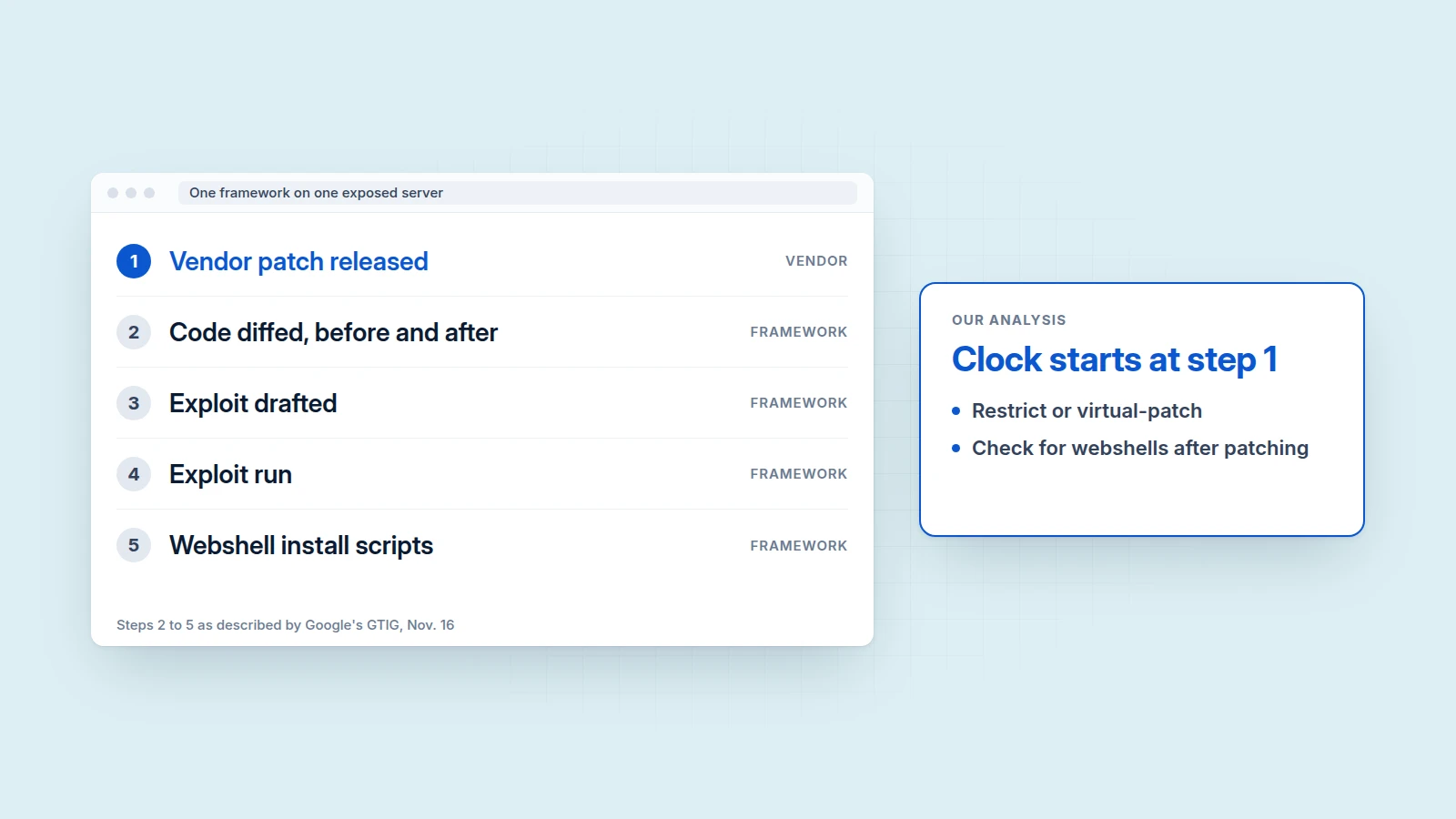
Oracle credits Quang Luong of Calif.io and, on a separate line, Albert Yang. Calif says Luong, using AI, needed an hour to find the bug and two more to write a first exploit, for under $200 in tokens. Our GTIG item covers why a fix release starts the attacker's clock.
What to do now
- Platform teams, today: start with internet-facing and pre-login Java. Calif reports pre-auth RCE in default configs of Keycloak, Jira, Confluence, Artifactory, Jenkins and PingFederate. It also reports RCE after login in Kafka, Solr, Elasticsearch, Gerrit and Spinnaker. That is Calif's test result. Keycloak's guidance says its 26.8.2 images bundle an affected 21.0.13 and attributes the RCE to "the researchers".
- Asset owners, this week: find runtimes by searching hosts and images for
javabinaries, not package entries. CISA says they "may not appear as separate entries in software inventories". Check each runtime's version andgrep avx512vbmi /proc/cpuinfo. - Cloud owners, this week: do not treat an older CPU as safe unless you pin the instance family. Red Hat's list of likely affected families includes AWS C6i/M6i/R6i and C7i/M7i/R7a, GCP C3, C4, N4 and M3/M4, and Azure D-series v5 to v7.
- Teams with a patchable runtime, today: update to the fixed builds (upstream 17.0.21.1, 21.0.13.1, 25.0.5.1, 27.0.1.1; Corretto and Zulu have them). As of Nov. 18 11:55 UTC, Debian stable, Ubuntu and Temurin 17, 21 and 25 were not yet fixed, and Red Hat listed its RHEL OpenJDK 17, 21 and 25 packages as affected with no fix released.
- Teams that cannot update, today: Red Hat's preferred interim step is
-XX:-UseBASE64Intrinsics;-XX:UseAVX=2also works, but only on x86-64, because ARM JVMs fail to start with it. CISA names no flag; it advises validating and size-limiting Base64 input and limiting unauthenticated access. For bundled runtimes, use the vendor's supported path and test first; do not rely on request buffering at a reverse proxy, which Calif says "is not a general mitigation". On managed Java platforms, ask the provider. - SOC, this week: watch for unexpected JVM crashes, which CISA lists as an indicator. Repeated crashes on internet-facing Java deserve a look.
What is not known yet?
Whether Atlassian, Jenkins, JFrog and Ping Identity confirm Calif's results, and which Java builds they bundle. Until they say, treat those products on an affected CPU as exposed and ask each vendor how to apply the flag.