 Facts checked Nov 27, 2026
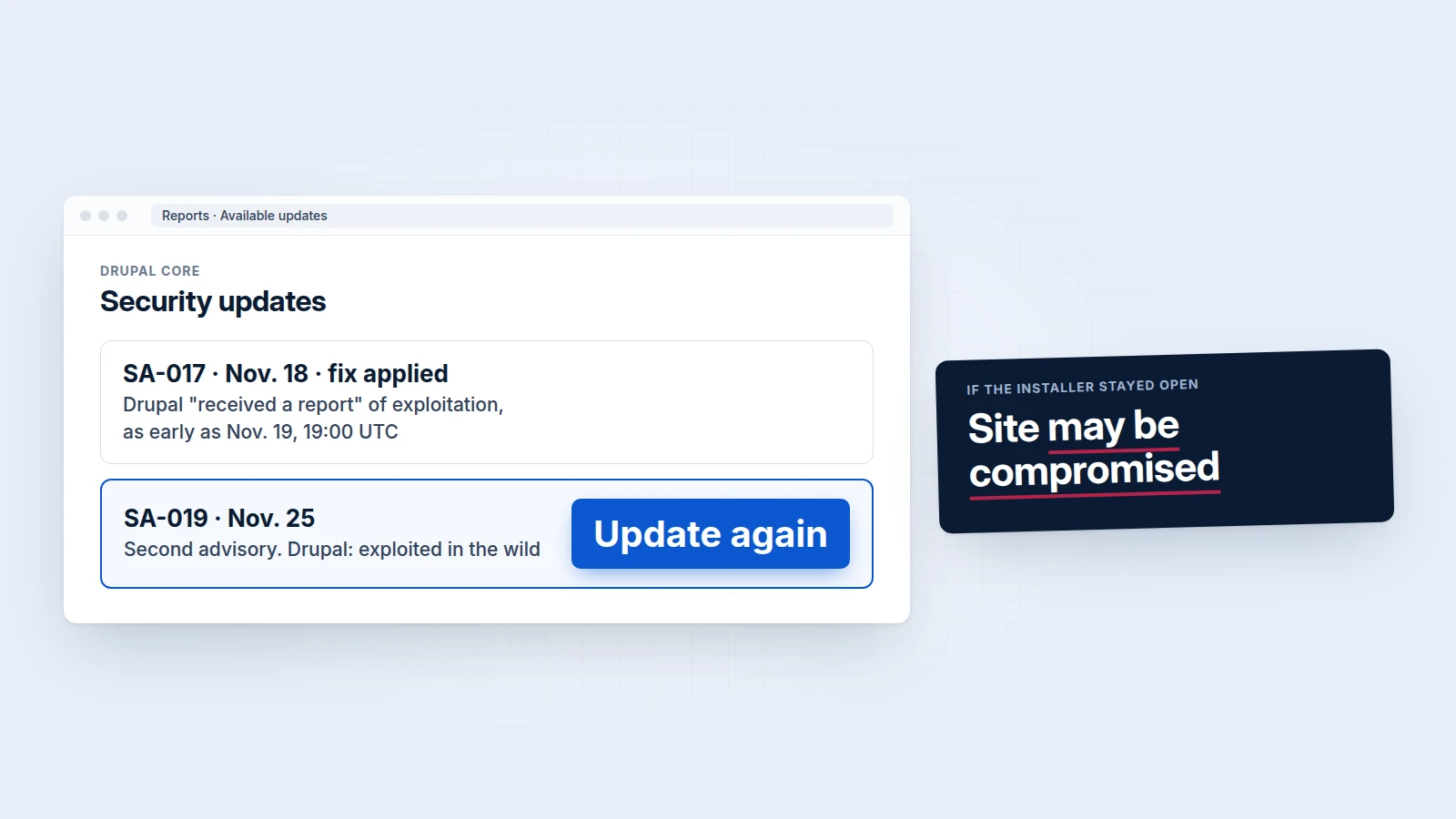
Drupal says sites left in "unusual or incomplete install states" stayed open to takeover after the SA-CORE-2026-017 fix and that it is being exploited, so patched sites must update again and run update.php. Any site whose installer stayed reachable after that fix should also check its user 1 account, because Drupal says a compromised site may no longer look vulnerable.
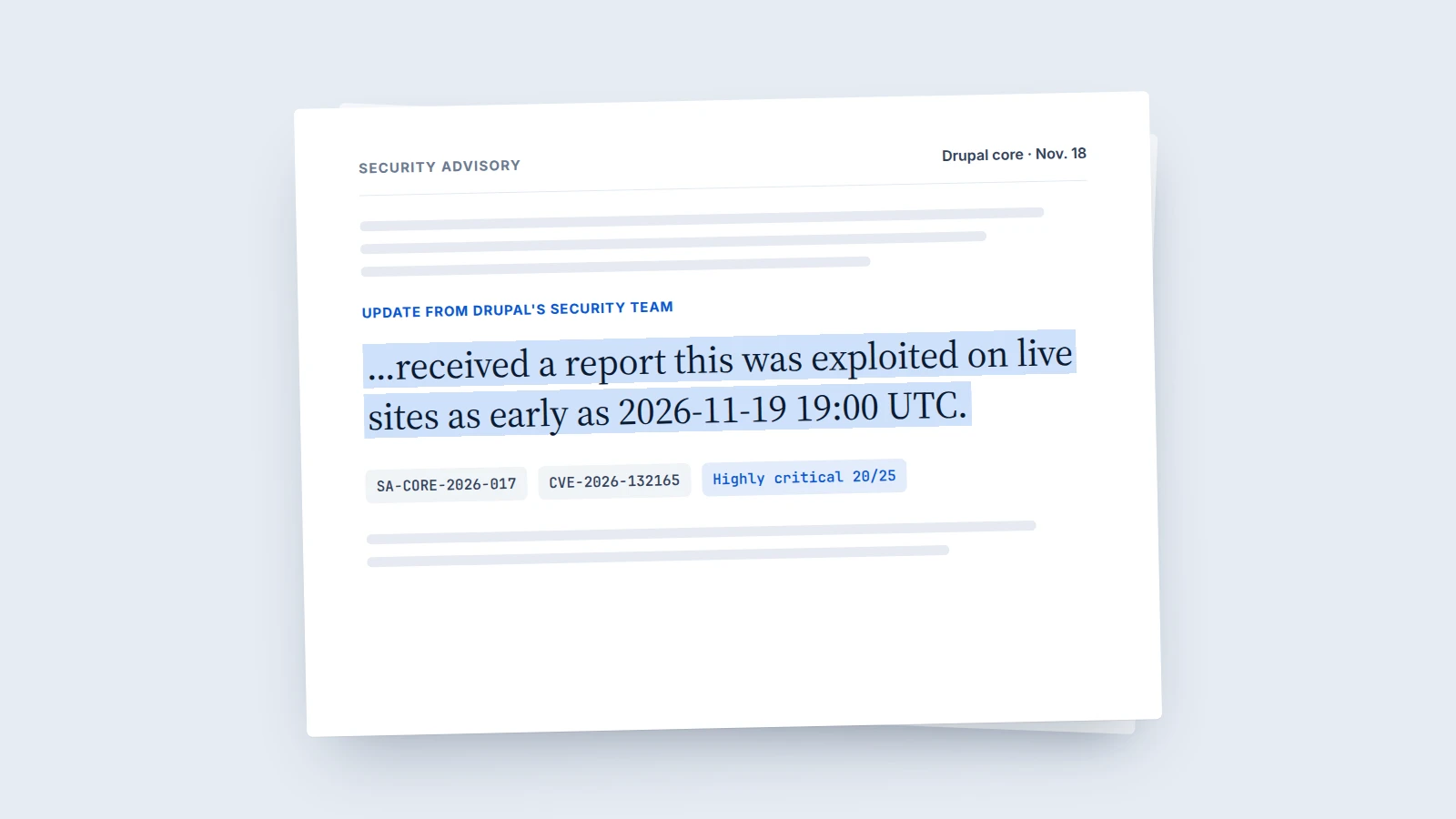
Drupal's SA-CORE-2026-019 (CVE-2026-136716), published Nov. 25, is rated Highly critical, 21 out of 25, with the attack complexity marked Basic. SA-CORE-2026-017, the installer advisory from Nov. 18, is rated 20 out of 25 with complexity Complex. SA-017 now says Drupal received a report that its flaw was exploited on live sites as early as Nov. 19, 19:00 UTC. Our Nov. 25 report listed only the SA-017 fixed releases; SA-019 had already been posted when it ran.
Drupal wrote that "certain sites in unusual or incomplete install states remain vulnerable to site takeover following that advisory, including production sites." Drupal also wrote: "This is being exploited in the wild." Drupal says the state is not visible in the user interface and that already compromised sites may no longer be in it, so a site that looks fine proves nothing. Drupal says any site that left its installer remotely accessible after SA-017 "may still have been compromised."
Who is affected
Drupal says that if you have already secured the installer, you are not vulnerable. The advisory lists affected versions as below 10.6.23, 11.0.0 up to but not including 11.3.23, and 11.4.0 up to but not including 11.4.14. Drupal 11.2.x and below and 10.5.x and below, as well as Drupal 8 and 9, are end-of-life and get no coverage.
Drupal says sites using Drupal Steward's recommended mitigations are protected from known attack vectors for both advisories, but it still advises upgrading soon.
What to do now
- Platform team, today: list every Drupal site and its version, including contractor and marketing sites.
- Platform team, today: update each site to 10.6.23, 11.3.23 or 11.4.14 and run update.php. Drupal wrote: "An update hook must run to fix existing production sites in this state." In our view, a pipeline that only ships code (a Composer update or an image rebuild) leaves the site unfixed. Confirm that no database updates are pending on each site. Drupal's release notes also say a Symfony security update issued the same day is not included and recommend updating Symfony along with core.
- Web operations, today: secure the installer on every site and test it, following Drupal's guide, which says: "Never leave a half-finished installation on a server that is reachable from the internet." The 403/404 test is in our Nov. 25 report. Do not block update.php with a broad rule.
- Incident response, today, for every site whose installer was reachable after SA-017: check logs for unauthorized access, especially unexpected changes to or by the user 1 account; confirm the user 1 email address is one you control, and consider resetting user 1's password. Those are Drupal's steps. Go back at least to Nov. 18, the day SA-017 shipped, or as far as your logs reach. We would also look for new roles, new admin accounts and sessions, which Drupal's general guide covers.
- Incident response, if anything looks off: follow Drupal's Your Drupal site got hacked guide and treat the site as an incident.
What is not known yet
Drupal gives no start date for exploitation of this flaw, no count of victims and no indicators, so you cannot rule out an earlier compromise from the advisory alone. Drupal credits members of its security team and others for the report. As of Nov. 27, the flaw is not in CISA's Known Exploited Vulnerabilities catalog.