 Facts checked Nov 25, 2026
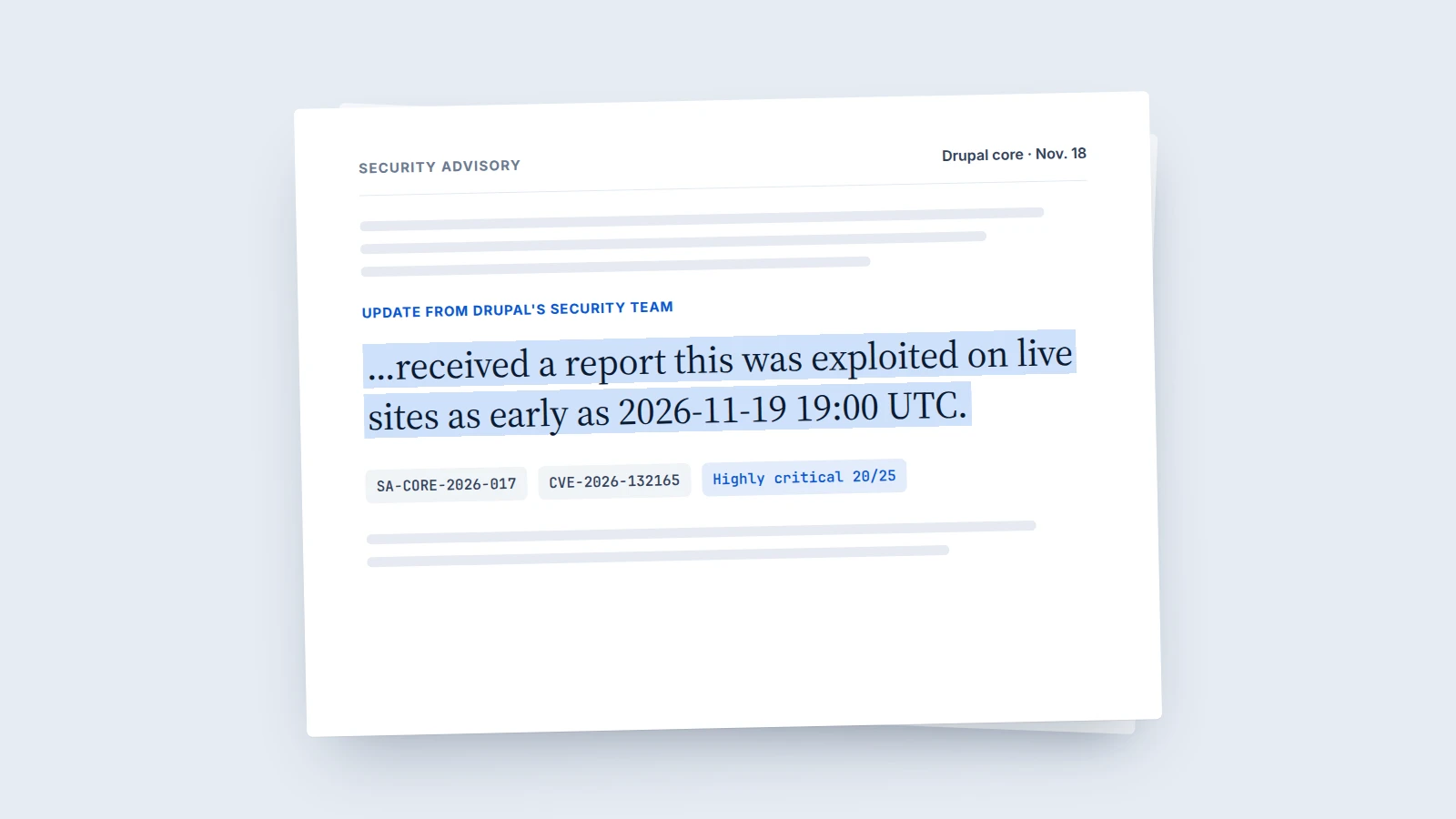
Drupal says an install.php flaw (CVE-2026-132165) was exploited on live sites as early as 19:00 UTC on Nov. 19, the day after its fix, so sites unpatched by then need a compromise check. Sites on end-of-life branches get no fix at all.
What happened
Drupal's advisory SA-CORE-2026-017, dated Nov. 18, says that under specific conditions an attacker can use the installer to attempt to reinstall Drupal, which can lead to site takeover or remote code execution. The advisory now rates it Highly critical, 20 of 25, with no authentication needed.
Drupal has since updated the advisory: its Security Team "has received a report this was exploited on live sites as early as 2026-11-19 19:00 UTC." As of Nov. 25, the advisory names no source for that report, gives no victim count and publishes no indicators. CISA added the CVE to its KEV catalog on Nov. 24, due Nov. 27 for federal agencies, and flagged forensic triage.
The advisory credits Anthropic's OSS Scanner with the discovery; Drupal, not Anthropic, reports the exploitation. Anthropic's scanner page lists an Oct. 8, 2026 launch and does not mention Drupal.
Who is affected
The advisory lists as affected all versions before 10.6.22, from 11.0.0 up to but not including 11.3.22, and from 11.4.0 up to but not including 11.4.13. The fixed releases are 10.6.22, 11.3.22 and 11.4.13. Drupal 11.2.x and below and 10.5.x and below are end-of-life and get no security coverage, so no fix is coming; Drupal 8 and 9 are end-of-life too. Drupal has published no count of exposed or compromised sites.
What to do now
- Web platform owner, today: list every Drupal site, including sites run by marketing or a contractor, with its version. Upgrade to a fixed release, or plan the move off an end-of-life branch.
- Web operations, today: block web access to install.php and make settings.php unwritable by the web server. Drupal says the settings.php step mitigates "some (but not all)" exploit paths and recommends securing the installer in addition to upgrading, so neither step replaces the upgrade. Drupal Steward customers are protected from known attack vectors, but Drupal still says to upgrade. Then test the block: Drupal's installer guide says an exact-match Nginx rule can leave variants of the path reachable, hand-added .htaccess lines are lost on
composer install, and a deleted install.php returns on each Composer run. Request the installer URLs and expect 403 or 404; a 200 means the block is not working. - SOC, this week, for any site that ran an affected version after 19:00 UTC on Nov. 19: Drupal publishes no indicators or check list, and we read CISA's forensic-triage flag on the KEV entry as a sign that patching alone may not close the case. We would look for a site reinstall or reset, new or changed admin users, changes to settings.php or the database, and unexpected PHP files in writable directories, and search web logs for install.php requests after the site was installed. Drupal says "as early as," so go back as far as your logs allow.
Where does AI fit?
An AI scanner found the flaw, and the first reported exploitation came about a day after the fix. Neither Drupal's advisory nor CISA's KEV entry says the attackers used AI or diffed the patch. We still read the timing as a fit with the attacker framework Google described on Nov. 16, which diffs web-app patches and runs the exploits. As with Java4Shell, whose finder says AI helped, the fix release is the public starting point for defenders and for a patch-diffing attacker alike. We would start the emergency patch clock at the vendor's release, not at the first exploitation report.