 Facts checked Nov 26, 2026
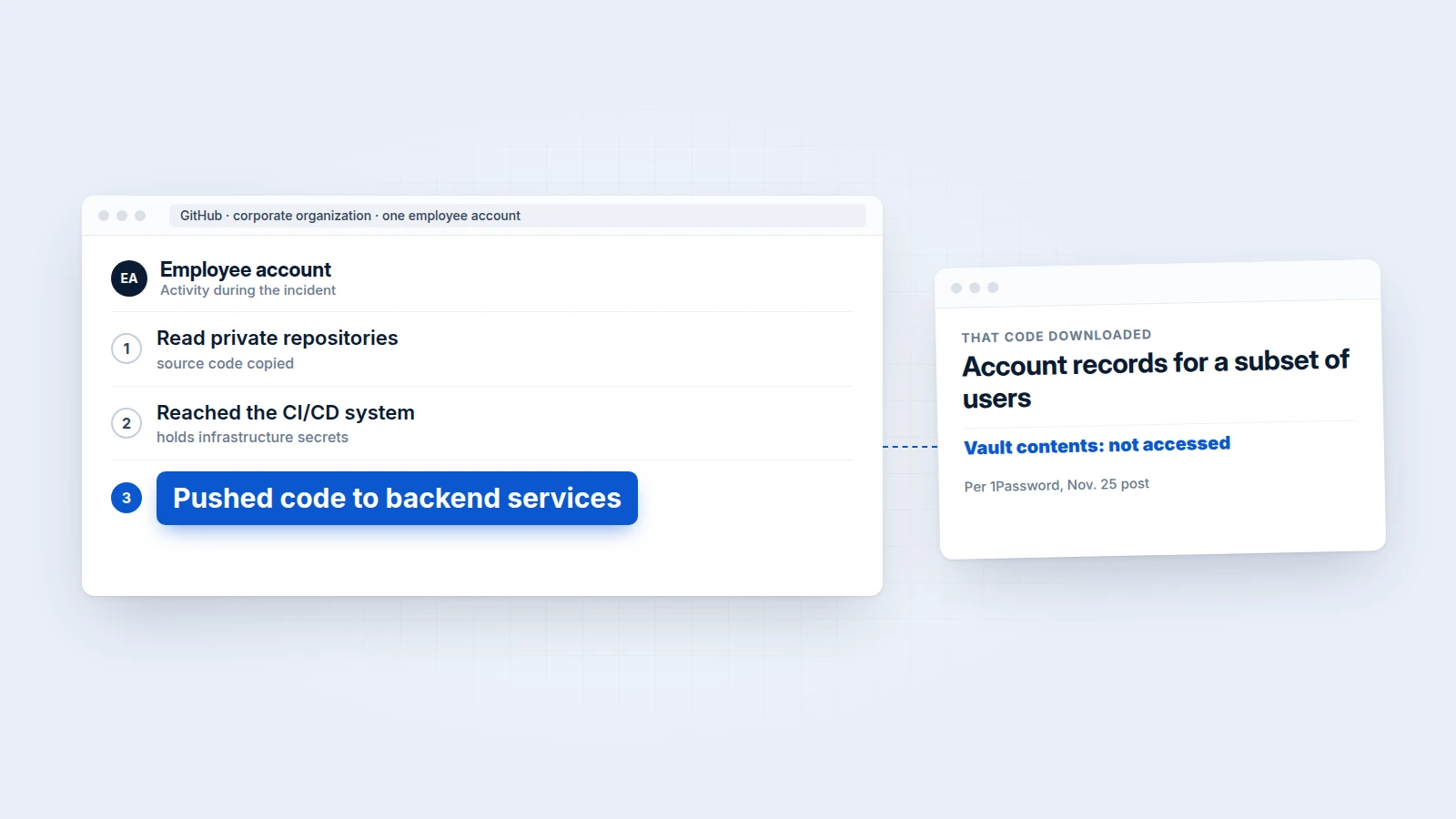
1Password said on Nov. 25 that an attacker used an employee's GitHub account to push code that downloaded account records for a subset of users; it says vaults were not accessed. 1Password says customers need not change anything; in our view the real risk is phishing aimed at the people whose names and emails were copied, and the wider lesson is for any company whose engineers can deploy from GitHub.
What happened
1Password said in a Nov. 25 post that on Nov. 19, 2026 it "began investigating indications that an attacker gained access to an employee's corporate GitHub account." The actor "used the account to access source code and push malicious code to backend services, which downloaded administrative data pertaining to our customers." 1Password said the attacker also copied source code from private repositories and gained access to its CI/CD system, which "contains infrastructure related secrets." It said it triggered a rotation of all credentials that may have been exposed.
1Password said: "At no time were customer vault contents accessed by, or available to, the attacker."
As of Nov. 26, 1Password's post does not say when access began or how the account was compromised. Its remediation list says it disabled the account and "revoked the stolen token" and gives no token type or theft method.
Who is affected
1Password said the attacker downloaded account records "for a subset of our users" and gave no count. According to 1Password, the records hold names and email addresses; account and user identifiers; account creation and last sign-in times; public keys; Secure Remote Password (SRP) protocol parameters, which 1Password said cannot be used to access an account; tokens in certain emailed invitation, provisioning and recovery links; and other non-secret internal metadata.
1Password also said that "a small number of users" had an open invitation or recovery email during the incident and that it notified them directly; it does not say how that group relates to the subset. Do not read "small number" as the size of the whole incident.
1Password said these were not affected: vaults and items, the keys that protect them, account passwords and Secret Keys (it does not store them), account recovery keys, and its apps and browser extensions. It said the emailed token completes an invitation or recovery only with an SSO sign-in or a six digit code sent to the user's registered email address, and it has made that code ten alphanumeric characters. It said it validated no internal evidence of account takeover using exposed provisioning tokens. The SCIM bearer token is not among the data 1Password lists.
What to do now
- 1Password users and admins, today: 1Password said "You do not need to update anything in your 1Password account." It advised caution with unexpected emails, texts or calls that mention 1Password, invitations or account recovery, entering credentials only in the app or a typed address, and reporting to support@1password.com.
- Admins and help desk, this week: we suggest warning users that phishing about invitations and recovery is now likely, and reviewing pending invitations and recovery requests you did not start.
- Platform and security leads, this week: we recommend running the chain below against your own GitHub organization. Taken-over GitHub accounts were the entry point in a separate case we covered, the wfx-loot campaign; 1Password has not tied its incident to any campaign or actor.
Step, per 1Password | Question for your organization |
|---|---|
Pushed malicious code to backend services | Who can push to branches that deploy, and do review and status checks bind admins too? |
Gained access to CI/CD, which holds infrastructure secrets | Which long-lived secrets does CI store, and can OIDC federation replace them? |
"The stolen token" 1Password revoked (type not stated) | Which token types are allowed, how long do they live, are classic tokens SSO-authorized? |
Copied source code from private repositories | Do audit logs stream to your SIEM, with alerts on bulk clones, new tokens and pushes from new IPs? |
Disabled account, revoked token | How fast can you disable one account and revoke all its tokens? |
GitHub documents rulesets with a bypass list and token policies with maximum lifetimes. Audit log streaming is documented under GitHub Enterprise Cloud, for enterprise owners. 1Password does not say which of these controls were missing.
What is not known yet
How the account was compromised, how long the attacker had access before Nov. 19, and how many users are in the subset are not stated. 1Password said it will update the post if anything changes; whoever owns your 1Password relationship should check it daily.