 Facts checked Nov 19, 2026
A database login with no table access can still reach the server's operating system: depthfirst says minimal PostgreSQL and MySQL logins could run commands as the database's OS account. Patch first (PostgreSQL fixed its bug Nov. 12; Oracle lists MySQL's fix in its Oct. 20 update), then revoke default temporary-table rights where apps do not use them and strip the host account of what it can read.
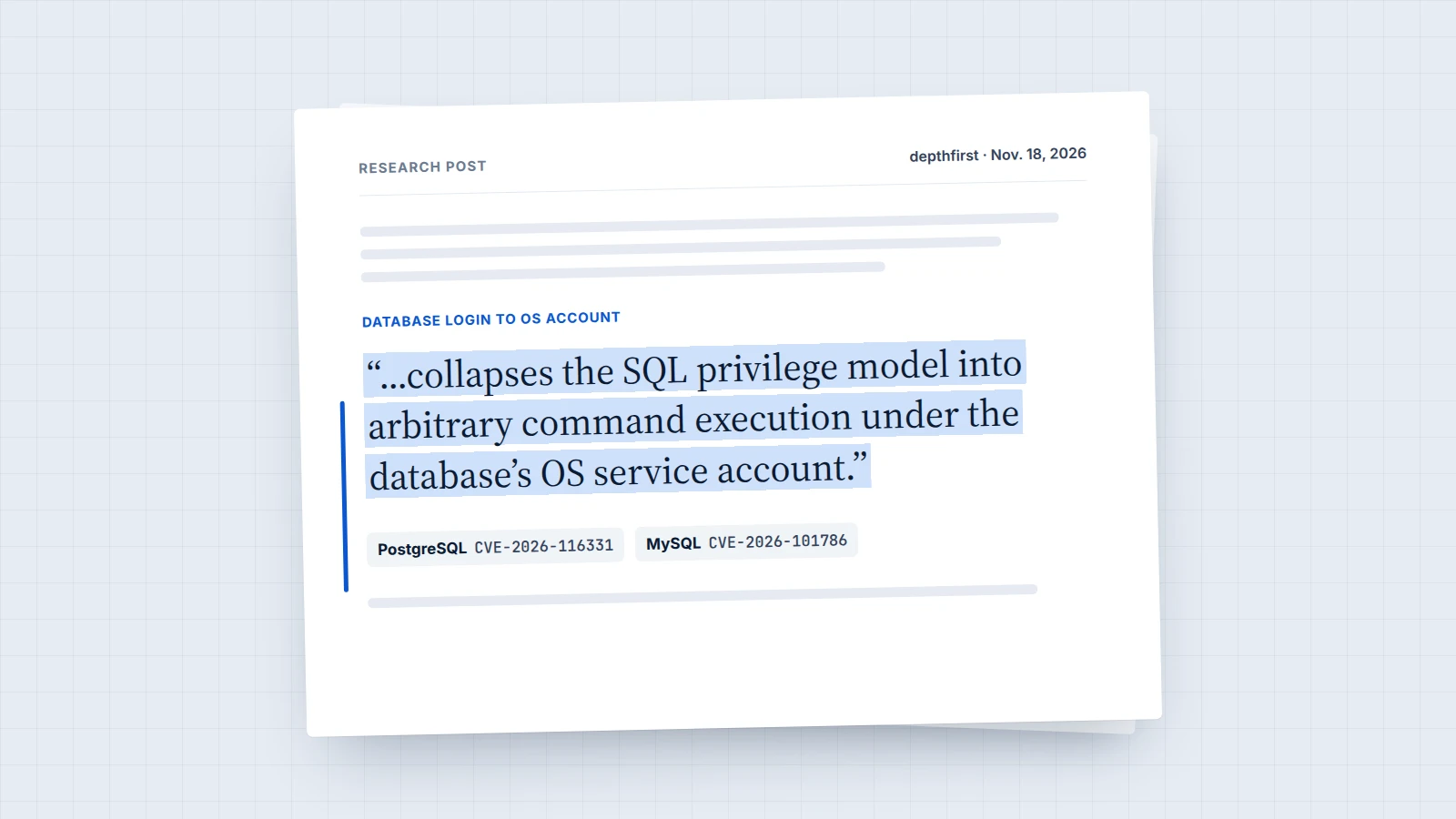
What happened. In a Nov. 18 post, depthfirst researcher Zheng Yu wrote that "a single memory corruption bug" in the engine code reachable by minimal accounts "collapses the SQL privilege model into arbitrary command execution under the database's OS service account." The post describes full chains in PostgreSQL (CVE-2026-116331) and MySQL (CVE-2026-101786), plus a ClickHouse bug it reproduced, for which it gives no CVE or fixed version.
PostgreSQL's advisory says a type confusion in min/max aggregate optimization "allows an object creator to execute arbitrary code as the operating system user running the database" (CVSS 8.8). Releases 18.7, 17.12, 16.16, 15.20 and 14.25 fix it, and the PostgreSQL release notice says PostgreSQL 14 is now end of life. depthfirst wrote that its chain used a new login role "with zero additional grants." PostgreSQL's privileges documentation says PUBLIC holds TEMPORARY on databases by default. The owner can revoke it.
For Oracle, depthfirst says CVE-2026-114819 chains with CVE-2026-91609, a flaw in the GraphQL interface of Oracle REST Data Services (ORDS), and that the chain works without authentication from the exposed HTTP endpoint. Oracle's advisories rate it differently: they list each CVE as not exploitable without authentication, with a Create Session privilege for the Oracle Text flaw, which Oracle still scores CVSS 9.9. Oracle fixed CVE-2026-91609 in its October 2026 Critical Patch Update and CVE-2026-114819 in the Critical Security Patch Update, released Nov. 17.
Who is affected
- PostgreSQL before the five releases above. We would treat any database with untrusted or semi-trusted logins as exposed: tenants, analysts, or an app account behind injectable code.
- MySQL: Oracle's October advisory lists only Server and Cluster 26.7.0-26.7.1. Oracle rates the privilege required High; depthfirst says its test user held only CREATE TEMPORARY TABLES ON ..
- Oracle Database 19.3-19.32, 21.3-21.24 and 23.4.0-23.26.3 (Text) and ORDS 24.2.0-26.2.1 (GraphQL), per Oracle.
- As of Nov. 19, neither depthfirst nor PostgreSQL or Oracle reports exploitation.
What to do now
- DBA, this week: move PostgreSQL to a fixed minor release; plan a move off 14. Apply the October 2026 Critical Patch Update to MySQL 26.7 and ORDS, and Oracle's Nov. 17 update to Oracle Database.
- Oracle DBA, today: find out whether ORDS is reachable and from where, and close it to the internet until patched.
- DBA, this month: revoke TEMPORARY on each database from PUBLIC where apps do not use temporary tables (test first; some ORMs and reports do). In MySQL, replace CREATE TEMPORARY TABLES ON . with per-schema grants or none. depthfirst wrote: "Revoking default TEMPORARY privileges in PostgreSQL or avoiding broad CREATE TEMPORARY TABLES ON . grants when applications do not need them raises the bar against post-authentication exploits, though pre-login paths like our Oracle chain bypass SQL role checks altogether."
- Platform team, this month: list what the database service account can read on the host, such as cloud credentials, mounted secrets, backups and other data directories, and remove or scope it.
- SOC, this week: alert on the database service account spawning a shell or opening outbound connections.
depthfirst also wrote: "Least-privilege roles are still essential for isolating data under normal operation, but a short output from SHOW GRANTS does not mean a small native attack surface."