 Facts checked Nov 20, 2026
If you patched PHP2Shell in October, upgrade PHP again: two advisories published Nov. 19 describe gaps in that fix, a third bug was made reachable by the release that shipped it, and the worst bug depends on whether your web server reuses FastCGI connections.
The PHP project released 8.5.13, 8.4.28, 8.3.37 and 8.2.36 on Nov. 19, 2026 as security releases. 8.6.0, a feature release, includes the same fixes. Together they close 17 php-src advisories, 7 rated critical (18 CVEs, counting a bundled uriparser update). PHP said the critical issues "require either non-default configuration or uncommon setups." FPM request smuggling needs no non-default PHP configuration, PHP says; its gate is the front end.
How does this connect to PHP2Shell?
PHP calls the session shutdown bug "an incomplete fix for CVE-2026-109619," the PHP2Shell use-after-free. For the backtrace repopulation bug, PHP says the 8.5.12 fix "did not stop later shutdown work from setting it again." For the magic-method backtrace bug, PHP says 8.5.12 introduced the delayed handling of an allocation failure that makes the bug reachable. The session serializer bug is separate, but PHP shows a gadget-chain RCE on October-patched releases.
Not every critical bug comes with demonstrated RCE. PHP shows code execution for FPM request smuggling, the magic-method backtrace bug, the serializer mismatch (with a gadget chain) and the timezone cache bug (locally), but not for the backtrace repopulation and session shutdown bugs.
Which hosts are exposed first?
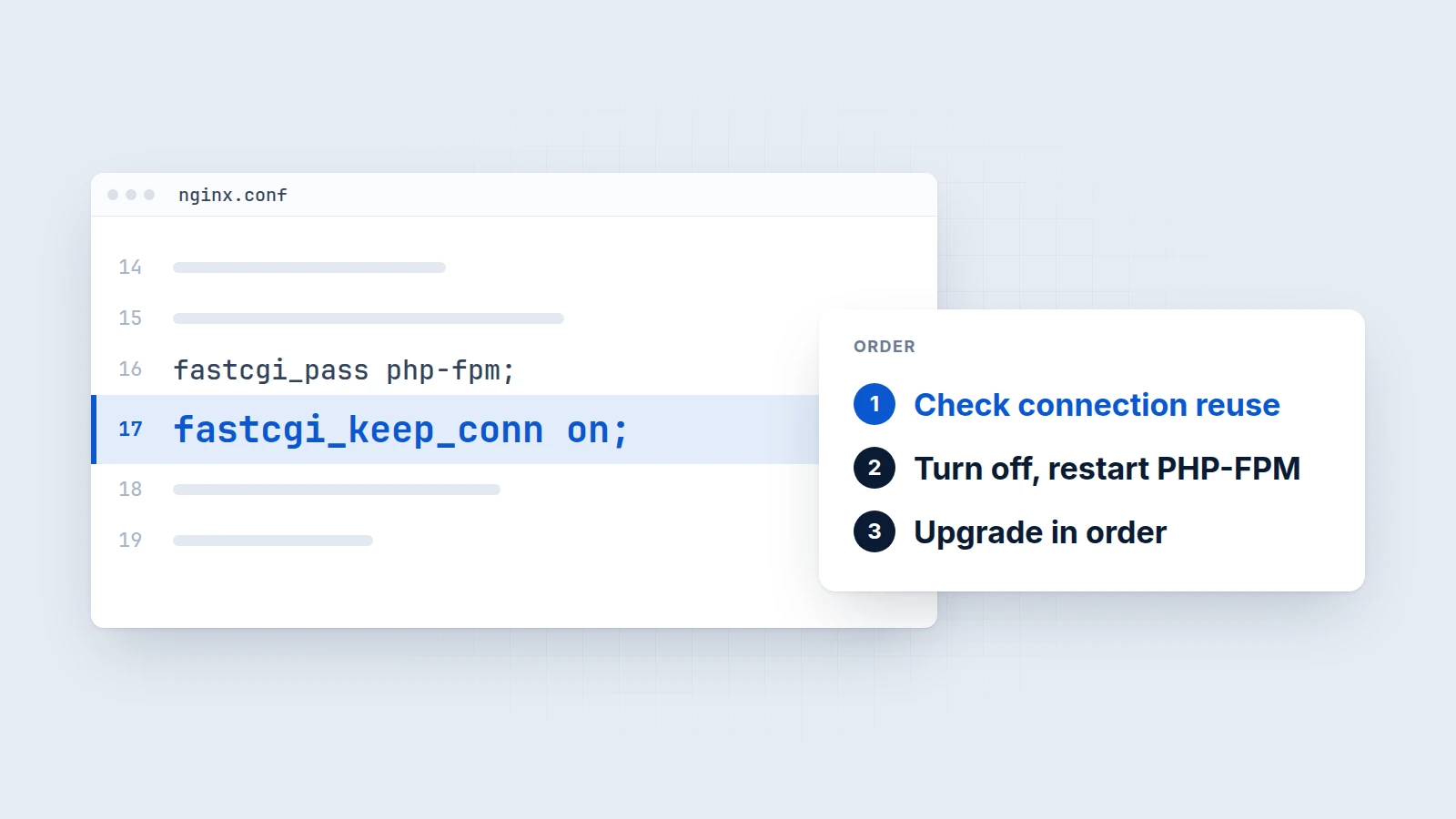
Start with the front end. PHP says standard nginx and Apache setups that close the connection after each request are not affected by the demonstrated smuggling attack.
Bug (branches) | You are exposed if | Interim workaround |
|---|---|---|
FPM request smuggling (all supported) | The front end reuses backend connections (nginx | Turn reuse off |
Magic-method backtrace (8.5 only) | | |
Backtrace repopulation (8.5 only) | Path-specific overrides plus an early diagnostic from Apache per-directory config or a | |
Session shutdown (8.3 and later) | A callback hits a fatal error during session cleanup | |
Serializer mismatch; partly overwritten session files (all supported) | Upload progress on with mixed serializers (a runtime change or a shared session store), or an interrupted write to default file sessions; both need a gadget chain | |
Timezone cache (all supported) | A startup diagnostic goes to a file | Fix startup warnings or log to syslog, restart |
We read fatal_error_backtraces=0 as the one interim setting that covers both 8.5 bugs.
Hosts on 8.1 and older got no upstream release. BleepingComputer says Ondřej Surý published patched packages back to 5.6. PHP's supported-versions page shows 8.2 security support ending Dec. 31, 2026, and 8.4 active support the same day.
What to do now
- Platform team, today: search nginx, Apache and HAProxy configs for connection reuse. Turn it off until the host is upgraded, and keep FPM and LSAPI listeners off untrusted networks. We would then restart PHP-FPM: PHP says a smuggled request can change admin-level PHP settings that stay active for later requests on the same worker, and can forge the client address the app's access controls see.
- Platform team, this week: upgrade hosts with connection reuse first, then 8.5 hosts not built from
php.ini-production, then the rest. Read the effective FPM or Apache ini. Distro builds can backport fixes without changingphp -v, so check the distro advisory. - App team, in staging this week: the fixed releases turn session upload progress off by default and reject runtime changes to session settings, including
session.serialize_handler, while it is on. An explicitsession.upload_progress.enabled=1keeps the old behavior and the exposure. The fix does not enforce matching serializers across configurations, and separate FPM pools do not get separate session storage automatically. Workers now exit on a failed request shutdown, so expect more restarts in FPM logs. - Vendor management, this week: ask vendors with embedded PHP for fix dates.
What is not known yet
As of 12:02 UTC on Nov. 20, none of the 18 CVEs was in CISA's KEV catalog (version 2026.11.18), and we found no exploitation reports from php.net or vendors. Whether any appliance on the NCSC-NL PHP2Shell list is affected by the FPM bug is unknown.