 Facts checked Nov 23, 2026
Microsoft closed an Azure API Management (APIM) access path on Nov. 19, according to a customer advisory reported by BleepingComputer, but the fix does not revoke secrets that may already have been read. Rotate them, and check your gateway's runtime build, as Norway's security authority advises.
What happened
Norway's National Security Authority (NSM) said on Nov. 20 that "an unknown actor has actively gone after access tokens, secrets and named values in APIM" (our translation). NSM wrote that Equinor and Skagerak Energi are among the organizations hit, that the flaw hits several sectors in Norway and also outside Norway's borders, and that it should now be closed. Equinor had disclosed an ongoing attack on Nov. 17 in a statement that does not mention APIM; on Nov. 20 it said the attack had been stopped and that there is "no indication that data has been stolen or altered."
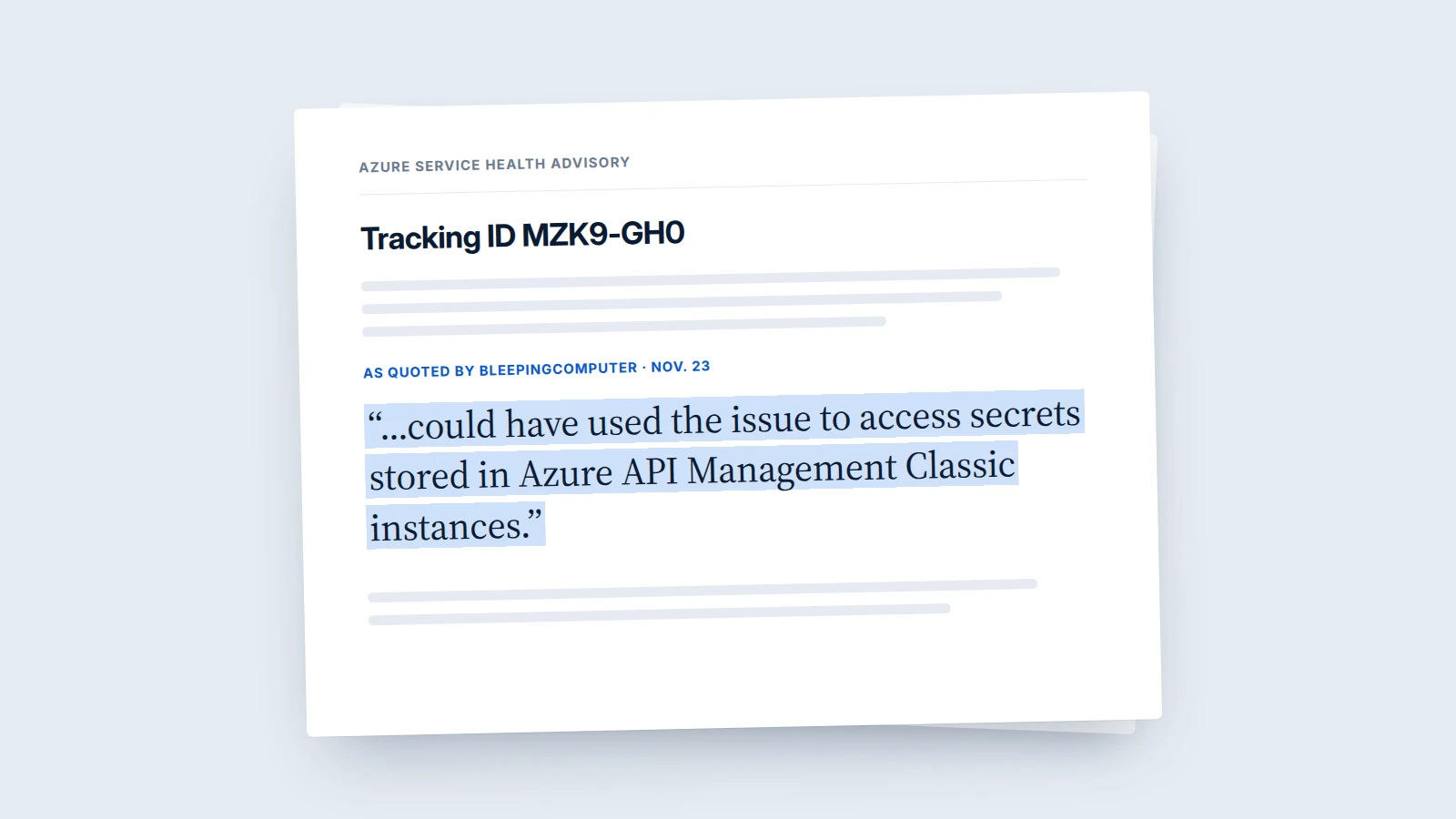
Microsoft's own text is not public. BleepingComputer reported on Nov. 23 that Azure Service Health advisory MZK9-GH0, sent to customers, says Microsoft identified the flaw on Nov. 18 and deployed a mitigation the next day. The advisory, as quoted, says "an unauthorized party could have used the issue to access secrets stored in Azure API Management Classic instances." It calls the flaw a "management-plane access path that could allow an actor to perform administrative operations, including secrets management." BleepingComputer's summary of the advisory says the flaw allowed unauthorized access to certain management functionality when Classic instances were "not configured according to recommended security best practices." BleepingComputer also reported that Microsoft rotated "Microsoft-controlled keys and credentials where appropriate" and urged customers to rotate potentially exposed credentials. BleepingComputer said it had not received a reply to its questions to Microsoft.
Who is affected
Per the advisory as reported, Classic tiers are affected and v2 tiers are not impacted. NSM's runtime check treats V2 and Consumption gateways as not vulnerable, yet NSM tells every APIM user to assume secrets leaked and rotate. We would rotate on every instance that ran a Classic tier (Developer, Basic, Standard or Premium), whatever its configuration; for v2 or Consumption alone, NSM's advice is the cautious one. NSM names no countries outside Norway, so whether US companies were hit is unknown.
What to do now
- Platform team, today: on each gateway, open
https://<your-gateway-hostname>/internal-status-0123456789abcdefand read RuntimeVersion. NSM says 0.52.x is patched at build 31936 or higher, 0.53.x at 31938 or higher, and a lower build is still vulnerable: contact Microsoft, or the partner that runs the instance. Other patterns are V2 or Consumption. - Cloud security with API owners, starting today: rotate what the advisory lists as possibly exposed: secrets stored in named values, client secrets for identity providers and for OpenID Connect providers, subscription keys, and tokens used to call direct management APIs. Also rotate any backend credential stored as a named value, at the backend itself, not only in APIM.
- API owners, this week: switch clients to the other key of each subscription-key pair and regenerate the first, which Microsoft Learn says causes minimal disruption. Move named values to Key Vault references; Microsoft Learn says vault updates reach APIM within four hours.
- SOC, this week: Map what information sits behind each instance, as NSM advises, and what each credential unlocks. We would start with backend, Entra ID sign-in, Key Vault and Azure Activity logs, looking for use from unfamiliar addresses or apps, and go back as far as retention allows. Because that path could allow administrative operations, we would also check each instance's policies, backends and subscriptions for changes you did not make.
What is not known yet
When exploitation began is unknown. The advisory as quoted says only "before Microsoft identified the security issue," so no date bounds the log review. Neither NSM nor BleepingComputer's account of the advisory names the setting behind "not configured according to recommended security best practices," so you cannot rule yourself out by configuration. BleepingComputer wrote that it is unclear whether NSM's runtime builds are the same fix as Microsoft's Nov. 19 mitigation, so treat the build check as NSM's.