 Facts checked Nov 21, 2026
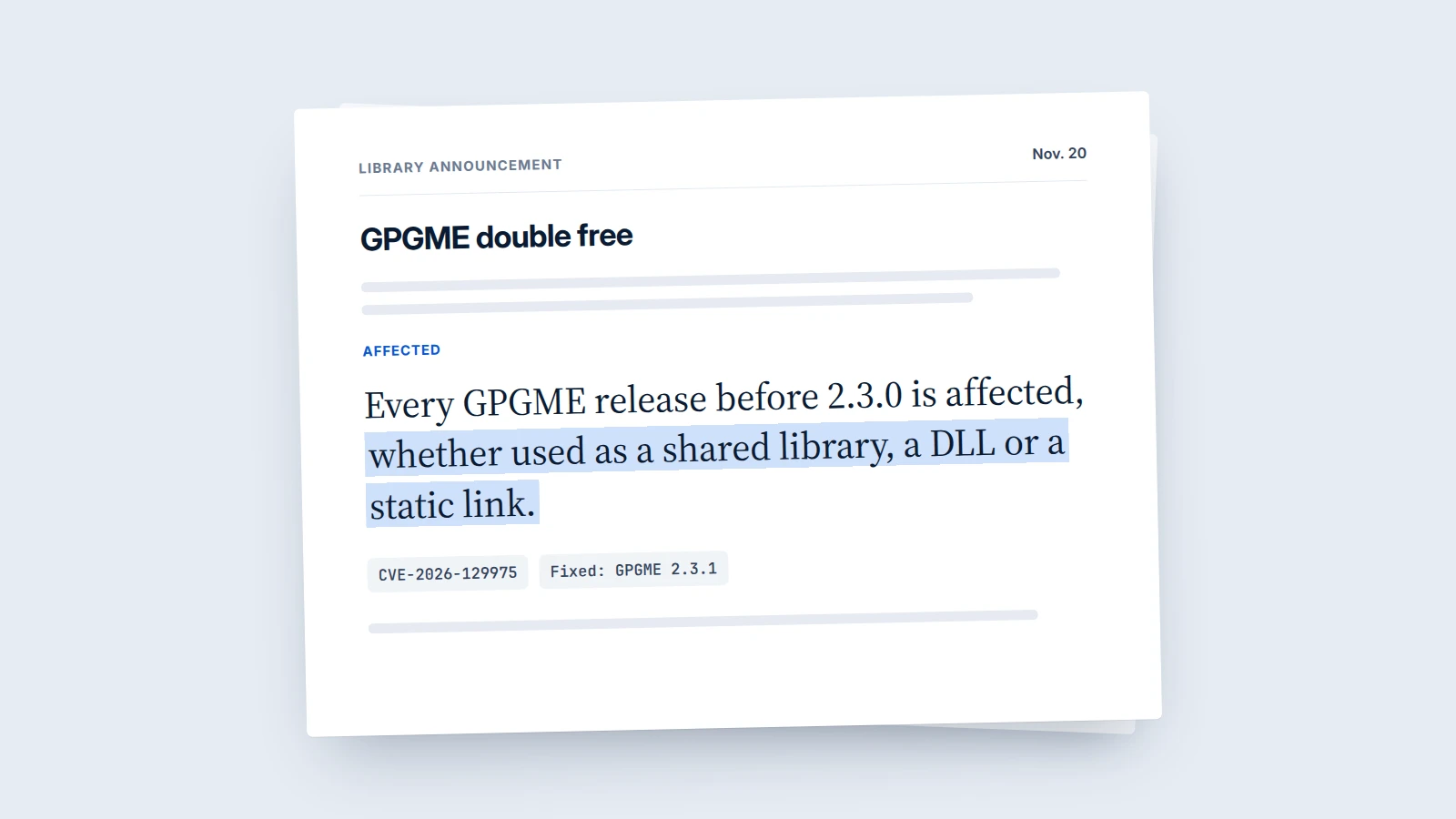
GnuPG said on Nov. 20 that GPGME has a critical double free; software that bundles or statically links the library needs a rebuild, so an OS package update will not reach every copy. In our view, copies that parse outside keys or signatures, such as mail clients and image signature checks, come first.
What happened
GnuPG described the flaw as a "critical security bug" in its Nov. 20 advisory (CVE-2026-129975, tracker T8557). Two GPGME functions that read gpg status lines and key listings mishandle an OpenPGP key with a crafted, very long user ID. GnuPG said this can be used to exfiltrate data from applications, "for example" via signed data, and that remote code execution "can't be ruled out."
GnuPG said Johan Carlsson found the bug and GitLab told GnuPG on Nov. 12. Disclosure moved from Nov. 25 to Nov. 20.
As of Nov. 21, no exploitation or public proof-of-concept had been reported, and the CVE had no NVD record or CISA KEV listing. SUSE rates it important (CVSS 8.1) and lists its gpgme packages as affected.
Who is affected
GnuPG said every GPGME release before 2.3.0 is affected, whether used as a shared library, a DLL or a static link. Version 2.3.0 was never released; the fix is GPGME 2.3.1, dated Nov. 19. GnuPG said GPGMEPP and GPGMEQT need no update. A legacy 1.24.4 release, dated Nov. 20 on gnupg.org, carries the fix for the 1.x API, though GnuPG warns that branch may not get every security patch.
GnuPG lists Gpg4win, GnuPG Desktop and VS-Desktop, "most mail clients," many XMPP clients, Samba and Flatpak as users.
What to do now
- Endpoint and Linux teams, today: apply distro and vendor packages as they ship, and judge by the advisory, not the version string. Debian fixed 1.18.0-3+deb12u1 on Debian 12 and 1.24.2-3+deb13u1 on Debian 13, so an "older than 2.3.0" check flags fixed hosts. Gpg4win 5.1.2 carries GPGME 2.3.1.
- Security engineering, this week: we would fix first where outside keys or signatures are parsed: mail and XMPP clients that verify incoming signed messages, and signature checks on external images or packages. Per its README, the containers/image library behind Podman and Skopeo uses GPGME by default unless built with its openpgp or sequoia tags, so check how your build was made. Samba ranks lower: its documentation ties GPGME to an optional feature, available only on AD domain controllers, that stores account passwords encrypted to keys the admin sets; patch it in the normal cycle. The flatpak tool links GPGME, and in our view Flatpak runtimes and app bundles may need their own updates too.
- Platform and AppSec, this week: find copies the package manager does not track: container images, SBOM entries for gpgme, libgpgme DLLs in Windows application folders, Flatpak apps, and static binaries. GPGME embeds the text "This is GPGME" and its version in the binary, so searching for it finds static copies. The version shown is upstream's, so a patched vendor build still reads old; ask the build owner when it shows anything below 2.3.1.
- Build owners, this week: rebuild static and vendored copies against 2.3.1, 1.24.4 for the 1.x API, or your distro's fixed source package. Rebuild images from a fixed base; do not patch running containers.
- Vendor management, this week: ask appliance and software vendors whether their products bundle GPGME and when a fixed build ships.
What is not known yet
As of 17:05 UTC on Nov. 21, Ubuntu and Red Hat had no page for the CVE and SUSE listed no fix announcement. Whether a distro's Podman or Skopeo package links libgpgme depends on its build tags; check its build spec or ask the distro.