 Facts checked Nov 28, 2026
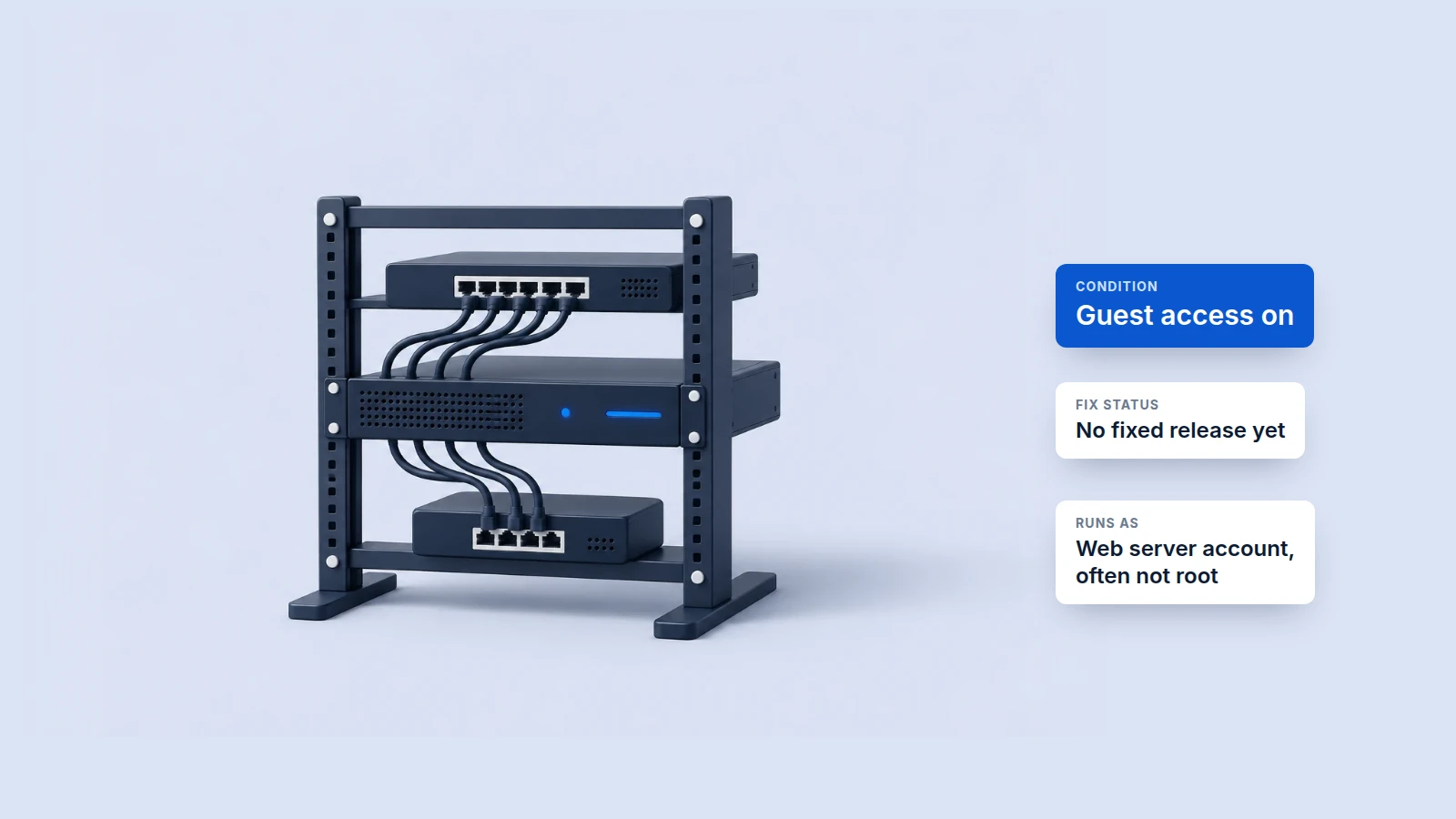
A chain published Nov. 26 lets an anonymous visitor run commands on a Cacti server when guest access is enabled, and as of Nov. 28 Cacti has no released fix. Turn guest access off and keep the web interface on a management network today, and if a server was reachable with guest on, treat the SNMP and device credentials it holds as exposed.
What happened
watchTowr, which calls the flaw 4HTTP2ROOT, describes it this way: an attacker with no account and no valid session starts as a guest and writes an unvalidated value into a per-user display setting. The value later reaches a database query that the server treats as more than one command. One of those commands changes a poller setting to a shell command, and a separate guest-reachable page then runs it. BleepingComputer cites RavenAI calling this a stored SQL injection, and says the exploit is now dubbed 4HTTP2SHELL.
According to BleepingComputer, the researcher said the flaw was not reported to Cacti before it was published. watchTowr said no exploitation in the wild as of Nov. 27, and BleepingComputer reported the same. An earlier unauthenticated Cacti flaw, CVE-2022-46169, was added to CISA's KEV catalog on Feb. 16, 2023, so we would not wait for exploitation reports.
Cacti's code is moving. As of Nov. 28, about 17:20 UTC, maintainers had merged three pull requests on GitHub: #9013 into the 1.2.31 branch, #9014 into 1.2.x and #9015 into develop. Their titles and descriptions cover blocking guest account changes and hardening user settings validation and realtime graph access. #9017 is still open. The maintainers' text does not tie any of them to this flaw. The latest release is still 1.2.31 from June 15, and there is no advisory or CVE. Treat this as code changes merged on GitHub, not yet in a release. It is not a reason to run branch code in production.
Who is affected
The researcher tested only Cacti Core 1.2.31, in an isolated lab, per watchTowr. BleepingComputer says it is unclear whether earlier versions are affected. The guest account must be enabled. Cacti's documentation says guest access is disabled by default and works only when the "Guest" user is enabled and set as the guest user. The documentation also says guest access suits pages where "you may wish to embed live Cacti Graphs in other corporate websites."
Commands run as whichever account runs the web server and poller, often a low-privileged web user rather than root, watchTowr said. BleepingComputer says the researcher demonstrated root access.
What to do now
- Network team, today: find every Cacti instance, including ones run by an MSP or another team. Then turn guest access off (watchTowr).
- Network and infrastructure security, today: restrict the web interface to trusted internal networks (watchTowr), such as a management network or VPN, and confirm from outside that it is unreachable.
- SOC, this week: review poller configuration entries for commands that do not match your normal polling setup. Search Cacti logs for warnings about a non-numeric value in a graph display setting, which watchTowr says appear even when the request succeeds. Look for new files created by the poller process's account (watchTowr).
- Network team, when a fixed release ships: upgrade, as watchTowr advises.
- Security and network teams, if you find signs or the server was internet-reachable with guest on: we would treat it as a network credential incident. Rotate the SNMP community strings, SNMPv3 credentials and device logins stored in Cacti, and review the access the Cacti host has to the devices it polls. watchTowr says Cacti stores such credentials and is "a central point of trust" in many enterprise networks.