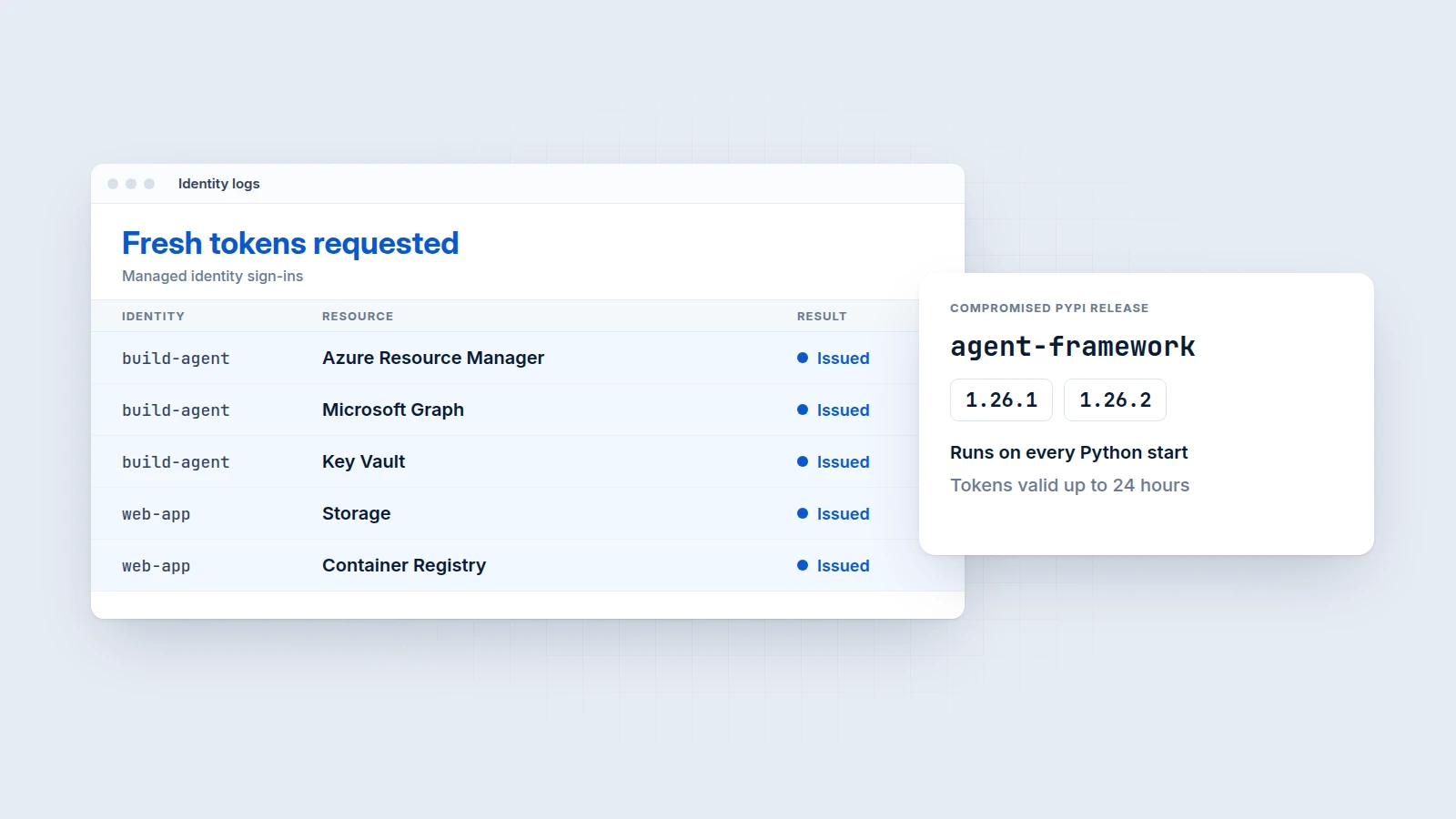
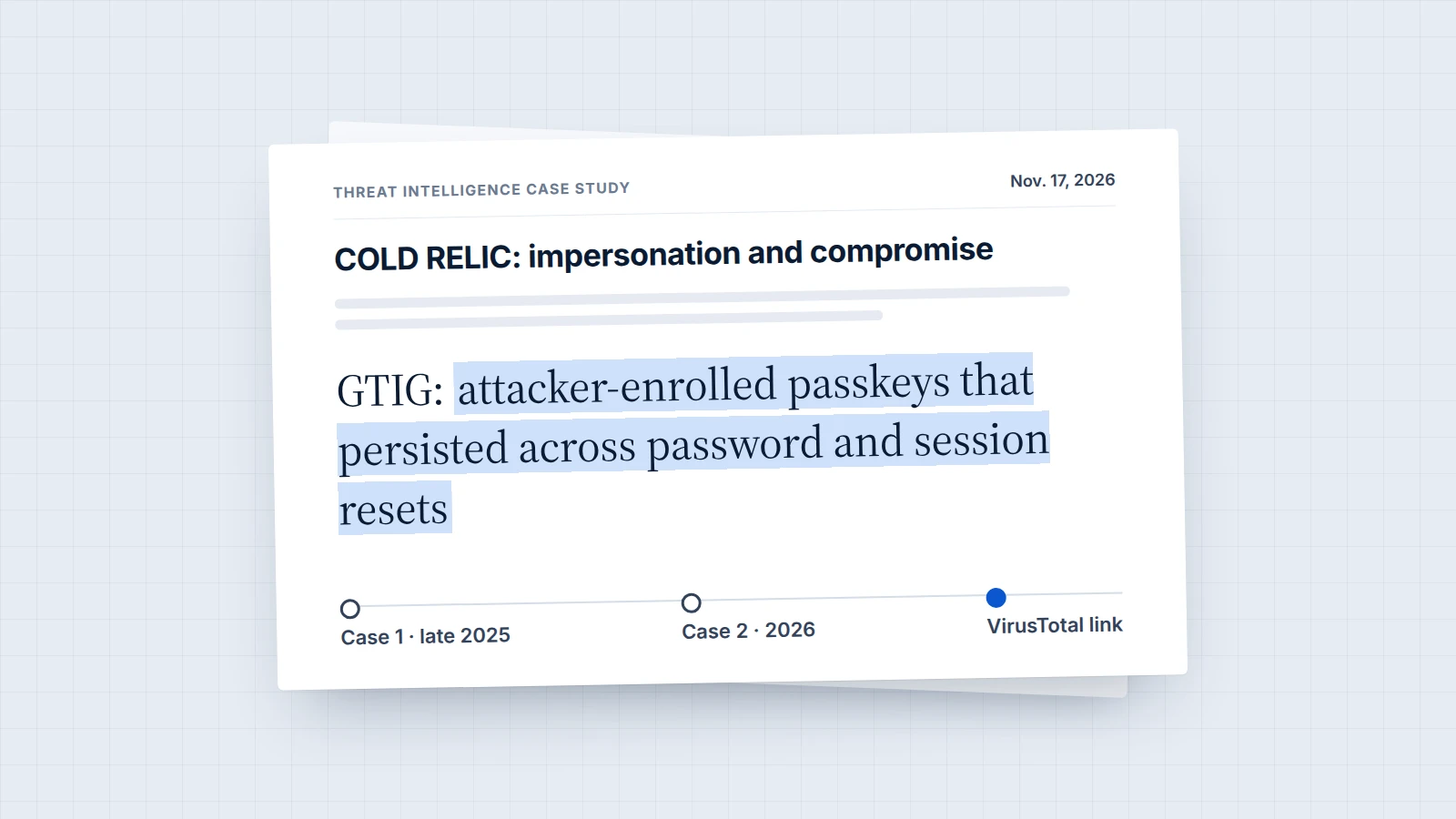
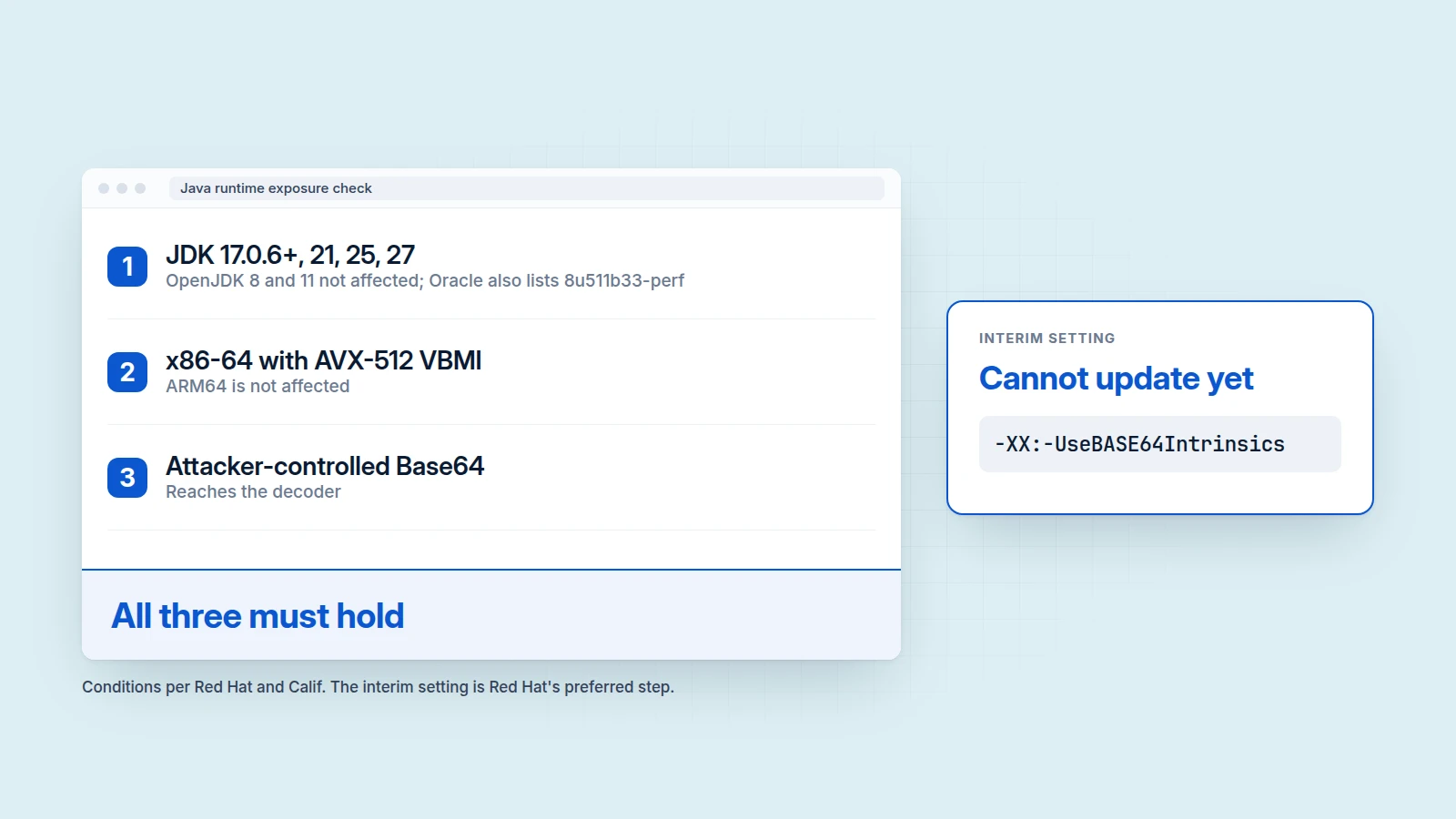
 Facts checked Nov 18, 2026
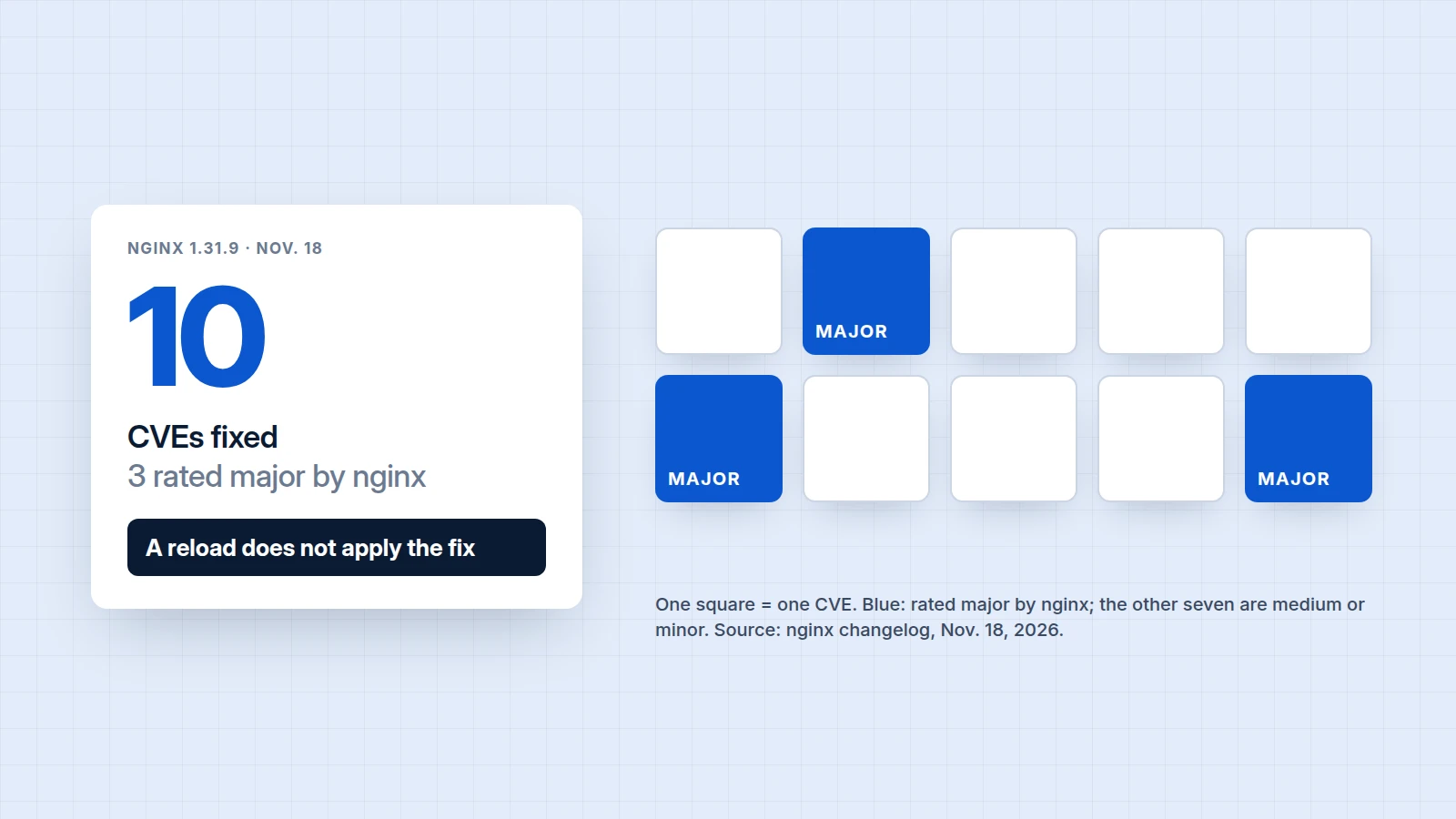
Find every nginx you run, including copies inside ingress controllers, images and appliances, because nginx 1.31.9 and 1.30.7 fix 10 CVEs and a reload does not apply the fix. Researchers ran code as the nginx worker through the HTTP/2 flaw in lab tests; Rapid7's proof of concept works only within narrow limits.
What happened
The nginx changelog lists both releases as Nov. 18. Xint's "nginx2root" set is five of the ten, the same five Wiz lists at CVSS 9.2. nginx rates only three of the ten "major": CVE-2026-123007 (HTTP/2), CVE-2026-118899 (TLS 1.3 request body) and CVE-2026-113425 (mail proxy). Its changelog credits Xint.io on four of them and "Albert of Vexera AI" on CVE-2026-123633.
CVE-2026-123007 affects 1.9.5 through 1.31.8 with HTTP/2 enabled; Wiz said it is exploitable in default configurations once HTTP/2 is on. Rapid7 published a proof of concept that ran code as the worker on a 1.31.8 Docker image. It listed the limits: about 128 GB of HTTP/2 traffic, a link above roughly 300 Mbit/s to beat the default one-hour connection lifetime, one x86-64 glibc memcpy path, and proxied HTTP/2 that "will likely not" carry it. Rapid7 said other strategies "may be viable" and that root "has not been established." Xint wrote that its route to root needs a separate, unpatched Linux kernel SCTP bug; CIRCL wrote that the disclosure gives it no CVE as of Nov. 18. CIRCL, the Luxembourg CERT, wrote that a vulnerable instance "does not by itself imply host-root access."
Xint wrote that a researcher found CVE-2026-123007 and "a fully automated Xint scan found the other four without human guidance." Wiz said its AI tooling, Wiz Atlas, found both HTTP/2 bugs, and that five teams found them independently. Xint counted 26 new vulnerabilities on nginx's advisory list this year by Nov. 17, against two in 2025; in our view that argues for a standing fast path to patch nginx.
As of 22:23 UTC on Nov. 18, none of the ten CVEs is in CISA's KEV catalog (version 2026.11.18). CIRCL called it "demonstrated exploitation in a research setting," not "by itself proof of widespread in-the-wild campaigns."
Who is affected
Exposure to the HTTP/2 flaw starts with HTTP/2 on a listener that clients reach directly. Wiz said CDNs and WAFs that terminate HTTP/2 may mitigate parts of the exploit, depending on implementation. Rapid7's table lists NGINX Plus fixes at 37.3.0.1 and 37.0.8.1 for CVE-2026-123007, and no fix for R34-R36.
Much exposure sits in copies nobody inventories. CIRCL said to check ingress controllers, gateways, appliances and images against their own vendor advisories, not the embedded version. The community Kubernetes ingress-nginx is retired and archived; its README says there will be "no updates to resolve any security vulnerabilities," and its last release was Mar. 19, 2026.
What to do now
- Platform team, today: list every nginx, including ingress controllers, images and appliances. Get each vendor's advisory. Inspect the nginx binary inside each image or appliance, not the host's own copy (CIRCL). Move off community ingress-nginx.
- Security engineering, today: find listeners with HTTP/2 or QUIC reachable without an HTTP/2-terminating proxy. Check
nginx -T; the running configuration can differ from the file. - Ops, within 48 hours: upgrade, then restart or do a binary upgrade. A reload does not replace the running executable (Xint, CIRCL). On Debian and Ubuntu,
nginx -vcan show an old version on a fixed package, so check the full package version. - Ops, if the upgrade waits:
http2 offcovers only two (CVE-2026-123007 and -123633). Removing QUIC listeners covers CVE-2026-121810. Fixed upstreams instead of request-time DNS block the tested path for CVE-2026-123634. Loopback or firewalled mail listeners cover CVE-2026-113425. - Linux admins, this week: where SCTP is unused, add
install sctp /bin/falseunder/etc/modprobe.d/. Xint said this does not unload a module that is already loaded or disable SCTP compiled into the kernel. - SOC, this week: watch for worker crashes, core dumps, commands launched by nginx and long HTTP/2 connections moving large volumes. Wiz called crashes and commands launched by nginx "general warning signs, not confirmed indicators"; clean access logs prove little (CIRCL).
Which configuration each CVE needs
CVE-2026- | nginx severity | Needs | |
|---|---|---|---|
123007 | major | HTTP/2 on | yes |
123633 | medium | HTTP/2, proxying, worker_connections exhausted | yes |
121810 | medium | HTTP/3/QUIC listener | no |
123634 | medium | request-time | no |
113425 | major | mail proxy with | no |
118899 | major | request body over TLS 1.3 | no |
120993 | minor | PROXY protocol v2 with dynamic certificates; 1.31.4-1.31.8 only | no |
125283 | minor | | no |
120967 | medium | stream client-certificate check with SNI | no |
123640 | minor | | no |