 Facts checked Nov 18, 2026
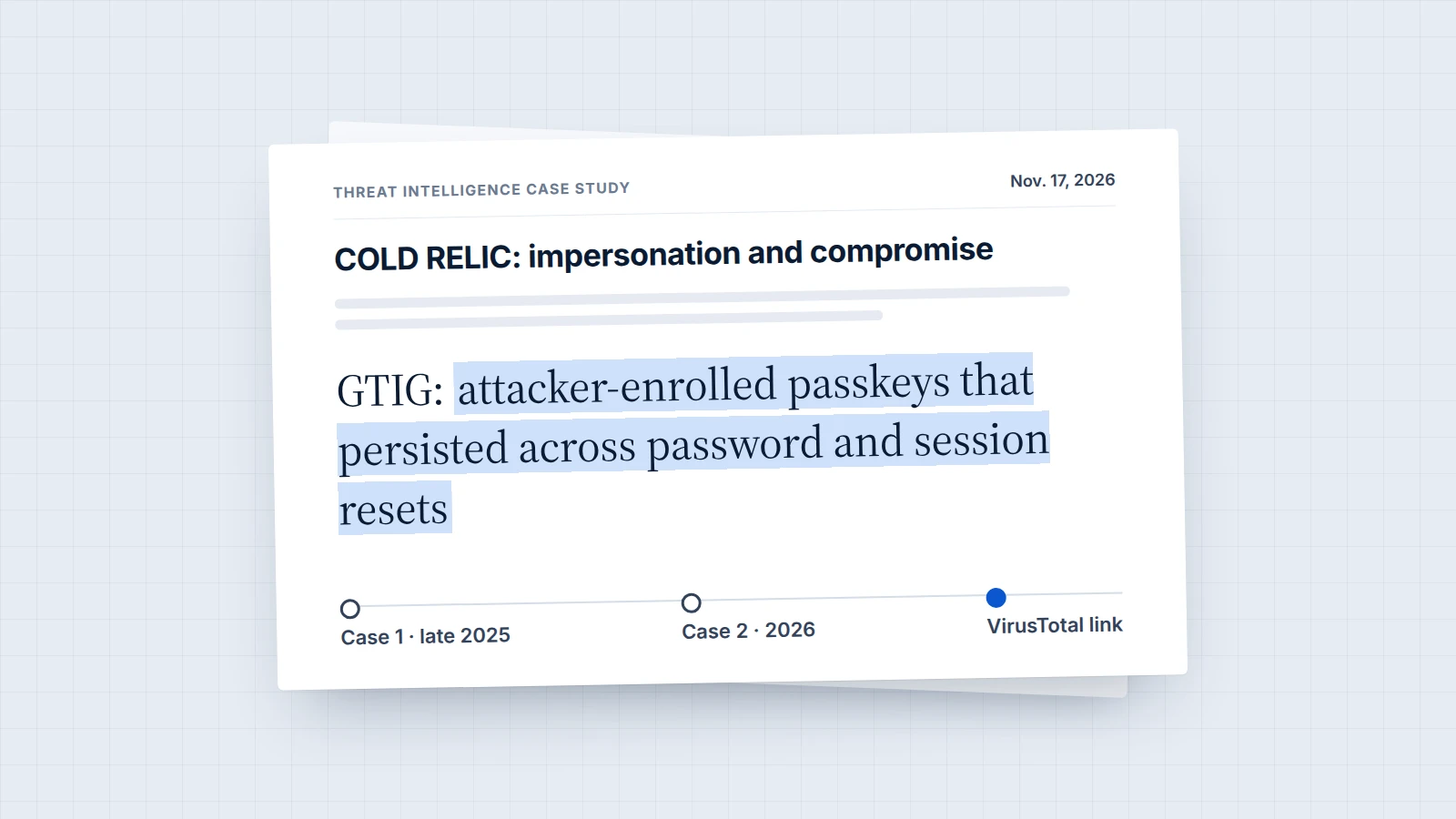
GTIG said Nov. 17 that COLD RELIC impersonated an employee of one breached US organization to approach a second, and that in at least one case a password reset alone failed to evict the group.
What happened
In its case study, GTIG calls COLD RELIC (formerly COLDRIVER, also Star Blizzard) a Russian state-sponsored threat group and says the US Department of Justice has assessed that it operates within Russia's FSB.
First intrusion, late 2025. GTIG said the group signed in with stolen Super Admin credentials plus MFA push fatigue, via a US residential proxy near the victim. It registered a device model never seen in the tenant and kept access with passkeys, MFA backup codes and rogue MFA devices. It pulled the entire cloud drive by mass sharing to its own mailbox and direct download, exported full employee lists and started a Customer Takeout. It queried audit logs and deleted Alert Center notifications. Access lasted several months, during which it synced inboxes via OAuth to external email clients and reauthenticated with attacker-enrolled passkeys that persisted across password and session resets. After removal, GTIG saw email accounts impersonating employees of the victim used against employees and associates in the same professional circles.
Second intrusion, 2026. GTIG said COLD RELIC contacted a user at a second US organization over an encrypted messaging app, impersonating an employee of the first victim. Phishing links stealing Entra ID credentials and tokens led to document lures. Entra ID was that organization's federated SSO provider for Google Workspace. The group registered a new MFA device in the SSO and bulk-downloaded files from the user's cloud drive. It then renamed the messaging profile; GTIG believes the new persona was likely used against other organizations in the same professional circles.
GTIG also correlated a redirector URL from the second intrusion, submitted to VirusTotal in June 2026, whose query parameter referenced the first victim. It says the pretexts likely drew on contact and relationship context from the first organization.
GTIG says the group hunts for credentials, .pst archives and personnel information, and for rosters, contact lists, resumes and event schedules to build pretexts; secrets in cloud drives let it reach other accounts, including personal ones.
Who is affected
GTIG says COLD RELIC targets government officials, defense contractors and NGOs in Europe and North America, and saw new phishing as recently as November 2026. The post describes two unnamed US victims and gives no wider count. Policy, defense and NGO teams should treat this as urgent; everyone else should take the playbook fix.
What to do now
- Identity team, today: add GTIG's eviction list to the account-compromise playbook: revoke all browser sessions, refresh tokens and third-party OAuth grants across both Workspace and Entra, and remove unauthorized passkeys, backup codes and MFA devices. In our analysis, a Workspace-only cleanup misses the MFA device registered in Entra, and because the passkeys survived session resets, removing them must be its own step. Review OAuth grants too.
- Identity admins, this week: require an existing administrator or out-of-band verification to approve new MFA devices and passkeys (GTIG's advice) and alert on backup-code sign-ins.
- SOC, this week: alert on the Workspace events in GTIG's table: Customer Takeout Created, User List Download, Batch Delete Operation Performed, Investigation Query, Passkey enrolled, Device Registered, and OAuth Authorize with the mail.google.com scope. GTIG says its proxies geolocate near the victim to evade impossible-travel alerts, so enrich sign-ins with proxy reputation and restrict admin logons from consumer ISPs, VPNs and known residential proxy ranges. GTIG gives no month for either intrusion; hunt back as far as retention allows.
- Security and comms, after any tenant breach: in our analysis, tell partners that impersonation of your staff may follow, and have staff confirm a "known contact" who writes on a new channel by calling a number you already hold.